Ten Things We Bet You Didn't Know About Pulaski County
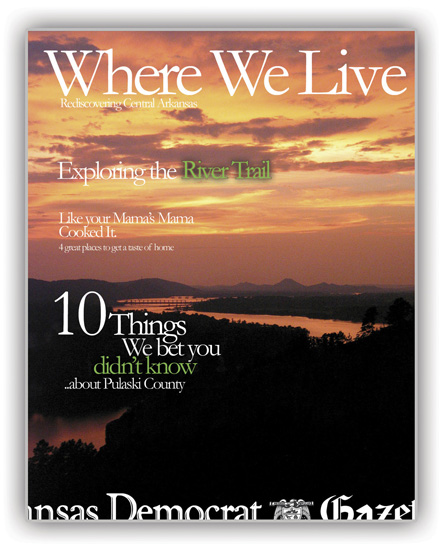
In late 2005 I was given the opportunity to write a small feature article for an upcoming special section of the Arkansas Democrat Gazette. Below is the cover-design and article I submitted for review.
Introduction
-
Hurriedly driving our cars to work in the morning, the steering wheel in one hand, ..donut or McMuffin in the other, many of us rarely give second thought to placenames and street names. Correction: replace "many of us rarely" with, " most of us never", and we're closer to the truth. Modern life has little time for history.
-
History lessons. Some of you perhaps are new to the area and haven't been here long enough for them. Others of us, have lived our entire lives around central Arkansas - perhaps thinking we know just about all of the important facts, only to find that even in this place we've grown up in, there are interesting parts of our local past that we haven't connected with, and yet, we know it well.
How does this happen?
Odds are, we just haven't had that little spark or interesting factoid tossed our way in conversation that makes us curious enough to learn more. History is everywhere. Pulaski County is a unique southern place, with an interesting past, littered with interesting events, and sometimes even more interesting characters. And unless you're related to a history nut, you may have to do a little digging to find out about them.
So let's start with a few of those interesting facts. 10 Pulaski County facts, in fact - that we're betting you weren't aware of.
1. Pulaski?
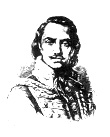
Take for instance the man who Pulaski County is named after. While in France, Benjamin Franklin made the aquaintence of one Count Casimir Pulaski, a Polish nobleman who had made his name fighting against Russia for his homeland in the mid 1700's. Having retired from his battles to France, Pulaski, already known throughout Europe for his military bravery, responded the Benjamin Franklin's invitation to serve in the struggle for American Independence; He fought under George Washington in the 1777 battle of Brandywine, and his performance earned him a commision as Brigadier General of the entire American cavalry. Later, in 1779, Pulaski was mortally wounded while bravely charging the enemy during the battle to recapture Savannah from the British . He was considered to be the "Father of the American Cavalry", and to this day is a well known figure of the Revolutionary War.
2. Douglas Mcarther
Both stationed at the Little Rock Arsenal in 1880, Douglas MacArthur's parents probably didn't realize that their little newborn bundle of joy was the Supreme Commander of Allied Forces in the Southern Pacific. They would find out later, when their son would become General "I Shall Return" Douglas MacArthur. The building of his birthplace now goes under a new name: "MacArthur Museum of Arkansas Military History".
3. Mount Holly Cemetary
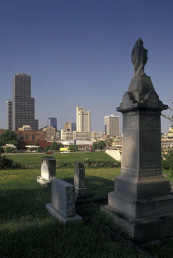
Few cemetaries if any are on the National Register of Historic Places. But on 12th and Broadway of downtown Little Rock they made and exception. With the graves of some 10 former governers, six US Senators, and 21 Little Rock mayors, not to mention 640 confederate soldiers - you can understand why many of the headstones go way beyond your ordinary average headstone.
4. A River of Change
Driving over any of several bridges that span the Arkansas River, you may not realize the extent to which this natural feature has shaped Pulaski County and the State of Arkansas. To put it simply, the river has had it's highs and lows, and even froze.
Major floods have tested our marriage with the Arkansas River, on several occasions. Take for example, the flood of 1833:
"In 1833 there occurred the most extensive and disastrous overflow, to both life and property, that had ever taken place on the Arkansas River within memory of the oldest inhabitant up to that time. The river began to rise about the middle of May, and attained it greatest height about the first of June. Whole plantations, with all their buildings, live stack and farming implements, were completely swept away. A number of human lives were lost in the devouring floods. The force of the current was so restless that where bends occurred in the river the water polished across the points of land made by these bends and created new channels, leaving the old beds of the river in the shape of lakes and bayous.
In several instances, farmers living on one side of the river went to bed at night to awaken the next morning to find their farms on the opposite side of the river to where they were located the day before."
Of course, the flood of 1943 would stay in the memory of many Arkansans. Some reports exaggerated the "Half of Arkansas was under water".
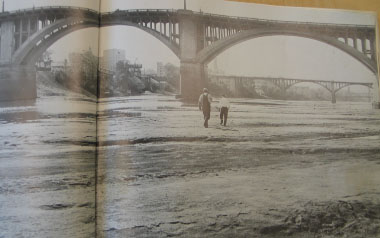
The River has had her low times as well. See the Gazette photo below from September 12, 1956, when the river trickled past Little Rock at its lowest recorded level, -4.6 feet, and you could almost walk across it.
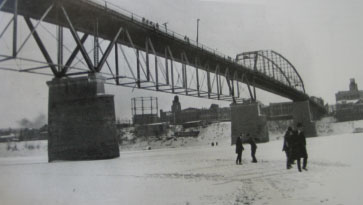
And on a few occasions its gotten cold enough for the River to completely freeze over:
5. Albert Pike
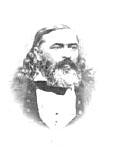
If a street in Hot Springs is the only thing that comes to mind, ..you're missing out on a great story. If they made a movie about Albert Pike's life, you'd swear they made it up - because this guy did it all.
Born and raised in Boston, but growing tired of Harvard admission fees and depressed about a girl he was too poor to marry, our man Albert leaves everything behind and heads out west with some friends on a journey that would climax in a failed fur trapping expedition in New Mexico; lost, without needed supplies, and hungry. For the better part of a year Albert Pike and his dwindling commrades make thier way across what is now New Mexico, Texas, and Oklahoma - reportedly, according to his estimations having walked the last 650 miles of the 1400 miles they had traveled since leaving Taos in December - finally crossing the river into Fort Smith in 1832, looking like savages. It was then that Pike would come on the scene and have a lasting effect on what was then the Arkansas Territory.
Pike would be a school teacher, run The Arkansas Advocate, his own newspaper - and in the Mexican American War lead a calvary company in the famous battle of Buena Vista, at one point charging the enemy lines with his mounted forces. Pike would later stand on a sandbar in the Arkansas River and "smoke a cigar enjoyably up to the very moment for the firing to begin" in a highly publicised duel with John Roan. "I want one more fire at him and will hit him in a vital part" Albert Pike was reported to have said, after surgeons for the two men convinced them to stand down after each firing two shots. "I believe he has tried to kill me; I have not tried to hit him."
Having a knack for picking up Indian languages, Albert would spend years acting as a lawyer for Choctaws, Chickasaws, and Creek Indians, winning multimillion dollar settlements from the Federal government, using his earnings he built the house that still stands in Little Rock on 7th and Rock street. (Now the Decorative Arts Museum).
Later, during the Civil War, Pike would be appointed brigadier general in command of Indian troops for the Confederate States, and be embroiled in controversy over his troop's actions during the battle of Pea Ridge.
There is more, much more to earn about Albert Pike. He was just getting started. Did we mention he was a famous Poet?
6. Munitions Plant in Jacksonvillle
If you are a woman with long, slender, sensitive hands that are nimble and sure-fingered, you are needed on the assembly line at the Arkansas Ordinance Plant, Jacksonville.
So read an advertisement during World War II. At its height of production, the munitions factory in Jacksonville, which made fuses and detonators, housed and employed 42,000 people. Nine trains shuttled workers to Little Rock and back.
You can learn a great deal more about the history of the Jacksonville Munitions Plant (and also get a peek at a solid bronze pickaxe; it wouldn't spark) by visiting the ever-expanding Military Museum in downtown Jacksonville.
7. The Bowie Knife
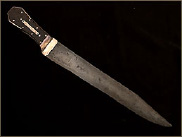
We've all heard the stories of Jim Bowie at the Alamo, and other stories of his exploits and famous knife.
There's a good chance you can see the actual knife Jim Bowie used in the Alamo, by visting the knife collection at the Arkansas Historical Museum. This special knife is on exibit with dozens of other knives of note, but viewing the Bowie No. 1 made by James Black will send chills up your spine.
Sidenote: During the very first legislative session back in 1836 at the Old State House, the speaker of the house killed one of his colleagues with a bowie knife on the floor of the state congress.
8. The Trail of Tears
More than 40,000 tribal people moved through the Little Rock and North Little Rock area during the time of Indian romoval in the 1830's. Either passing through on the Arkansas River or being ferryied across, large groups of Native Americans were common during the time.
9. The Spanish Flu
In 1918, the Influenza Epidemic, (similar to the current bird flu outbreak feared in China) killed about 7,000 Arkansans. In October of that year, on average 200 new cases were reported in Little Rock every day, and 13,000 men at Camp Pike were sick with flu.
In Argenta (present day North Little Rock) Dr. William M. Burns, later mayor elect Burns, walked door-to-door treating victims.
Burns Park would later be named in his honor.
10. Speaking of Burns Park...
Burns Park in North Little Rock is the second largest city park in the United States, at 1,575 acres. Who knew?
Sources:
25 Years of Arkansas Gazette Photography: 1950-1975
Amazing Arkansas by Ken Beck and Terry Beck
More than a Memory, Little Rock's Historic Quapaw Quarter
A Documantary History of Arkansas
Images of American, Jacksonville Arkansas
Early Days in Arkansas
On the Opposite Shore: The Making of North Little Rock
A Life of Albert Pike, by Walter Lee Brown